
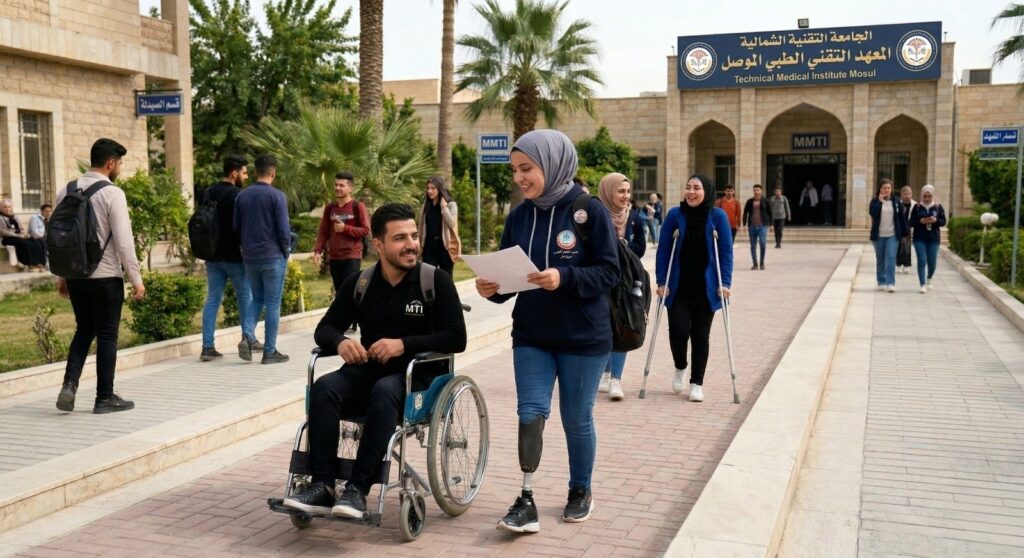
1. Introduction and Departmental Vision
The Department of Emergency Medical and Care Techniques is committed to fostering an inclusive, equitable, and safe educational environment that guarantees all students, regardless of their diverse abilities, the full right to academic achievement and clinical/field training. Our vision stems from the firm belief that the emergency medical care sector accommodates all competencies and minds; therefore, through this manual, the department seeks to provide the necessary regulations and accommodations that ensure the empowerment of students with special needs, directing their potential toward excellence in emergency planning, crisis management, and clinical training, while strictly maintaining patient safety and medical quality standards.
Objective of the Manual: To define the rights, duties, and organizational/facilitative mechanisms that guarantee the integration of students with special needs into theoretical lectures, emergency simulation labs, and field training periods (in hospitals and ambulance centers), ensuring their independence and safety, as well as the safety of patients.
2. General Regulatory Principles (Legal Reference)
This manual is based on national higher education and scientific research legislation, laws and regulations governing the care and empowerment of persons with disabilities, and relevant international conventions. It is centered on the following pillars:
Equal Opportunity and Non-Discrimination: Guaranteeing the student’s right to education, evaluation, and fair training without any exclusion based on the nature of their specific needs.
Universal Access and Smart Accommodation: The commitment of the department and the institute to adapt lecture halls, interactive simulation labs, and digital media to suit the physical or sensory capabilities of the student.
Strict Data Confidentiality: Handling medical reports and student personal files with absolute confidentiality; these documents shall only be circulated within the narrow scope concerned with providing accommodations and only with the student’s explicit consent.
3. Academic and Environmental Accommodations in the Emergency Medical Department
Given the highly sensitive nature of this specialization (which encompasses skills such as Cardiopulmonary Resuscitation (CPR), airway management, trauma response, and patient evacuation), the legally approved accommodations include:
A. Laboratory Environment, Clinical, and Field Training:
Emergency Simulation Labs: Adapting training stations and interactive educational manikins to specific heights and angles that facilitate access and manipulation for students with physical disabilities, and providing dedicated seating during long training scenarios.
Assistive Technology and Software: Permitting the use of vital signs monitors and defibrillators supported by audio-reading features or enlarged screens to assist students with sensory needs.
Adapted Field Training (Hospitals and Ambulances): Coordinating with hospital administrations and immediate care centers to allocate roles and tasks in training environments that match students’ physical capacities (such as assigning tasks in managing and directing digital emergency medical dispatch, logistical disaster planning, or working within emergency department triage units) to ensure the safety of both the student and the patients.
B. Theoretical Lectures and Academic Evaluation:
Flexible Evaluation and Examinations: Granting students additional time in theoretical exams and Objective Structured Clinical Examinations (OSCE), and adapting exam formats to convert written skills into digital or oral forms that match the student’s condition and learning difficulties.
Accessibility of Educational Media: Providing advanced Emergency Medical Services (EMS) Protocols and life-support manuals in flexible electronic formats that support searching, zooming, and text-to-speech to facilitate academic achievement.
4. Mechanism for Obtaining Support and Privileges
To benefit from these policies and regulations, please follow these administrative steps:
Submission of Application: The student submits a formal request to the “Special Needs Care Committee” in the department at the beginning of the academic year.
Supporting Documentation: Attaching an official and certified medical report outlining the nature of the need and the recommended accommodative provisions from competent medical authorities.
Approval of the “Individualized Accommodation Plan”: The department coordinates with academic advisors and field training supervisors to develop a customized support plan that ensures the student’s safety and their attainment of the core competencies and essential skills required in the Emergency Medical specialty without compromising vital professional standards.
5. Rights and Duties
| Student Rights in the Emergency Medical Department | Student Duties and Professional Commitment |
| Learning and training in a safe, respectful environment, completely free from any form of bullying or discrimination by any party. | Strict compliance with occupational safety and infection control protocols within laboratories and in the field. |
| Provision of flexible options and equivalent alternatives in field training if health constraints prevent working in specific environments. | Early and honest disclosure of the medical condition to ensure the timely provision of a safe and appropriate working and training environment. |
| Access to continuous academic and psychological counseling to guide the student toward career paths best suited to their abilities (e.g., EMS dispatch operations management, emergency education/training, and triage). | Diligent effort to achieve the extreme speed and precision required in making critical emergency medical decisions to protect patients’ lives. |
6. Follow-up and Complaints Committee
If a student encounters any difficulties in activating the accommodations approved for them, or faces environmental or academic barriers within the department or at field training centers, they have the right to submit a formal written complaint or grievance to the Head of the Department. The departmental administration is committed to reviewing the request immediately and coordinating with the relevant authorities to take appropriate corrective actions within a period not exceeding (5) working days, in order to safeguard the student’s academic and professional journey.
Department Message: Your passion for saving lives and your insight in managing medical crises are the core of your excellence, and there is no barrier that stands before your ambition; the Department of Emergency Medical and Care Techniques is your support and partner to become a vital element in the immediate care system.