
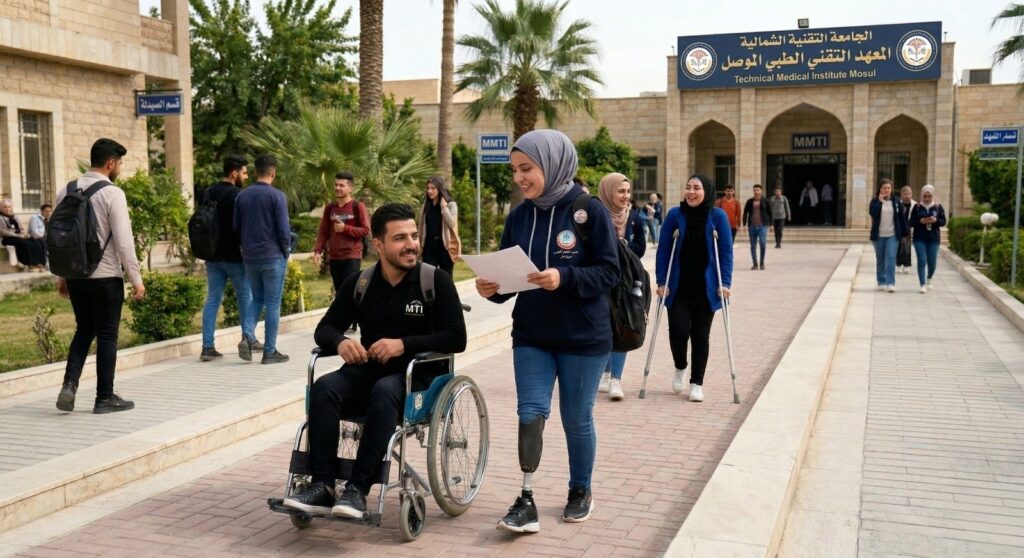
1. Introduction and Departmental Vision
The Department of Anesthesia Techniques is fully committed to providing an inclusive, equitable, and safe educational and academic environment that guarantees all students, regardless of their varying abilities, the full right to receive outstanding education and high-quality clinical training. Our vision stems from the firm belief that competence in anesthesia sciences relies on academic intellect, scientific vigilance, and humanitarian responsibility. Therefore, through this manual, the department seeks to provide all necessary facilities and regulations to empower students with special needs and channel their capabilities toward excellence, while strictly maintaining patient safety and medical quality standards within operating theaters and intensive care units (ICUs).
Objective of the Manual: To define the rights, duties, organizational, and facilitative mechanisms that ensure the integration of students with special needs into theoretical lectures, simulation laboratories, and field clinical training periods in hospitals. This ensures their independence and safety, as well as the safety of patients undergoing anesthesia.
2. General Legislative Principles (Legal Reference)
This manual is based on national higher education legislation, laws, and regulations concerning the care and empowerment of individuals with disabilities and special needs, as well as relevant international conventions. It is centered on the following core principles:
The Right to Integration and Equal Opportunity: Guaranteeing the student’s right to education, training, and fair evaluation without any exclusion or discrimination based on the nature of their needs.
Universal Access and Smart Adaptation: The commitment of the department and the college to adapt the educational environment, simulation labs, and digital media to align with the physical or sensory capabilities of the student.
Absolute Data Confidentiality: Handling medical reports and personal student files with absolute confidentiality. These records shall not be circulated except within the narrow scope concerned with providing accommodations and only with the student’s explicit consent.
3. Academic and Environmental Accommodations in the Anesthesia Techniques Department
Given the critical nature of this specialization (which includes endotracheal intubation, calculated anesthetic drug dosages, blood gas monitoring, and operating complex anesthesia machines), the approved accommodations include:
A. Laboratory Environment, Clinical, and Field Training:
Anesthesia Simulation Labs: Adapting educational anesthesia workstations, machines, and smart manikins to be at accessible angles and heights for students with physical disabilities, and providing dedicated, comfortable seating during long simulation sessions.
Assistive Technology and Software: Allowing the use of patient monitors equipped with text-to-speech features or magnified digital screens to assist students with sensory needs in reading and auditing vital signs and electrocardiograms (ECG).
Adapting Field Training (Operating Theaters and Intensive Care): Coordinating with hospital training management to distribute tasks in training environments in a way that matches students’ capabilities (such as assigning tasks for pre-operative assessments, monitoring and documenting patients’ digital vital records, working in recovery rooms, or intensive care units) to ensure the safety of both the student and the patients.
B. Theoretical Lectures and Academic Assessment:
Assessment and Examination Flexibility: Granting students additional time in theoretical exams and Objective Structured Clinical Examinations (OSCE), and adapting exam formats to rephrase written skills into digital or oral forms that suit the student’s condition and learning difficulties.
Accessibility of Educational Resources: Providing anesthesia pharmacology textbooks and mechanical ventilator operation manuals in flexible electronic formats that support searching, magnifying, and text-to-speech tools to facilitate academic achievement.
4. Mechanism for Obtaining Support and Privileges
To benefit from these policies and regulations, please follow these organizational steps:
Submitting the Application: The student submits a formal request to the “Special Needs Care Committee” in the department at the beginning of the academic year.
Supporting Documentation: Attaching an official and certified medical report that explains the nature of the need and the recommended accommodation proposals from medical authorities (especially if the student suffers from hypersensitivity to anesthetic gases or certain chemical materials).
Approving the “Individual Accommodation Plan”: The department coordinates with academic supervisors and clinical training coordinators to develop a tailored support plan. This plan ensures the student’s safety and their attainment of the core competencies and essential skills required in the anesthesia specialization, without compromising vital professional standards.
5. Rights and Duties
| Student Rights in the Anesthesia Techniques Department | Student Duties and Professional Commitment |
| Learning and training in a safe, respectful environment that is completely free from any bullying or discriminatory practices by any party. | Strict commitment to sterilization, occupational safety, and infection control protocols inside operating theaters and laboratories. |
| Providing flexible options and equivalent alternatives in clinical training if there are health constraints that prevent working in specific environments. | Early and honest disclosure of any health condition (such as hypersensitivity to inhalational gases) to ensure a safe and appropriate training environment. |
| Receiving continuous academic and psychological counseling to guide the student toward the career paths best suited to their capabilities within the fields of anesthesia and intensive care. | Diligent striving to achieve the utmost vigilance and precision required in calculating drug dosages and monitoring the patient to protect human lives. |
6. Follow-up and Complaints Committee
If a student faces any difficulties in activating the accommodations approved for them, or encounters environmental or academic obstacles within the department or inside the operating theaters of teaching hospitals, they have the right to submit a formal written complaint or grievance to the Head of the Department. The department administration is committed to reviewing the request immediately and coordinating with the relevant authorities to take appropriate corrective actions within a period not exceeding (5) working days, out of keenness to support their academic and professional journey.
Department Message:
“Your scientific vigilance and humane care for the patient’s life are the foundation of your excellence, and there is no obstacle that stands in the way of your ambition. The Department of Anesthesia Techniques is your anchor and partner to be a vital and successful member of the medical team.”