1. Introduction and Department Vision
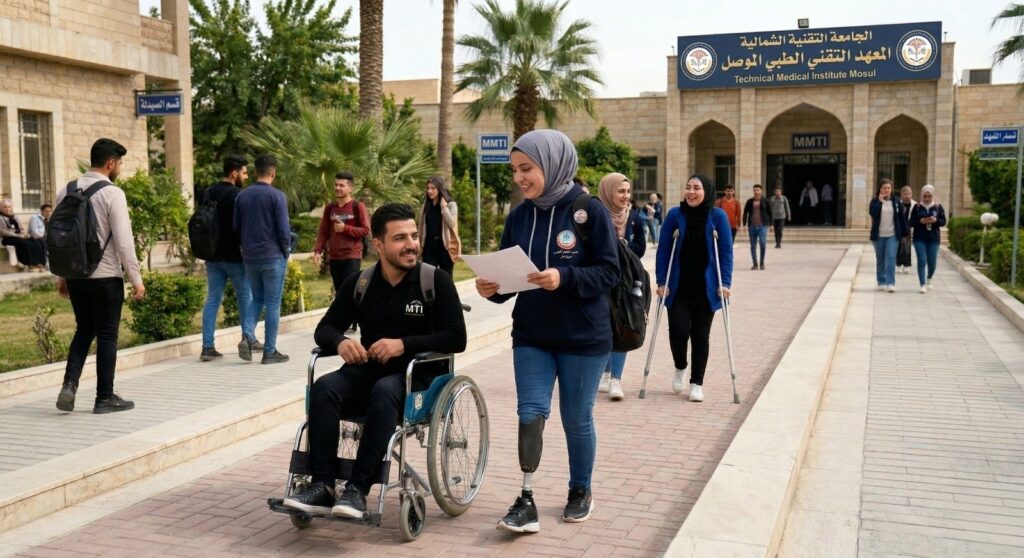
The Department of Community Health Techniques is driven by a firmly rooted academic and humanitarian vision that believes community health is achieved through the integration of the efforts of all its members, with their varying capabilities. The department is committed to providing an inclusive, equitable, and stimulating educational environment that guarantees all students, particularly those with special needs, the full right to receive outstanding education and high-quality field training. Our goal is to overcome all academic and environmental obstacles to qualify technical cadres capable of leading awareness campaigns, promoting public health, and managing preventive programs efficiently and competently.
Purpose of the Guide: To define the rights, duties, and regulatory mechanisms that ensure the integration of students with special needs into theoretical lectures, practical laboratories, and field training periods (in primary healthcare centers and community surveys), while fully maintaining academic quality and occupational safety standards.
2. General Legislative Principles (Legal Reference)
This guide is based on national legislation for higher education and scientific research, laws concerning the care and empowerment of persons with disabilities and special needs, as well as international conventions. It is centered on:
Non-discrimination and Equal Opportunity: Guaranteeing the student’s right to education, participation, and fair evaluation without any exclusion or marginalization due to the nature of their need.
Universal Access and Environmental Adaptation: The commitment of the department and college to adapt classrooms, laboratories, and educational media to suit the physical or sensory capabilities of the student.
Absolute Data Confidentiality: All medical files and reports belonging to the student are kept strictly confidential and are only circulated within the narrow scope concerned with providing accommodations, and with the student’s explicit consent.
3. Academic and Environmental Accommodations in the Department of Community Health Techniques
Given the nature of the department, which combines scientific study with community awareness field work (such as conducting environmental surveys, food and water testing, health education, and vital statistics), the approved accommodations include the following:
A. Laboratory Environment and Field Training:
Environmental and Food Health Laboratories: Adapting laboratory stations and testing equipment (such as analytical balances and microscopes) to be at heights and levels that are easily accessible and usable by students with physical disabilities.
Adapting Field Training and Surveys: When organizing awareness campaigns or field surveys in the community, the department is committed to distributing roles and tasks in proportion to the students’ capabilities (such as assigning tasks for digital planning, vital statistical data analysis, or preparing scientific and educational materials for students who face difficulties with long field travel).
Assistive Technology and Software: Allowing the use of statistical package software (such as SPSS) supported by screen-reading features, or audio amplification tools for students with hearing and visual impairments during the delivery of educational lectures.
B. Theoretical Lectures and Academic Evaluation:
Flexibility in Evaluation and Exams: Granting students additional time in theoretical and practical exams (especially exams for communication skills and health project presentations), and providing digital or oral formats for exams in accordance with the student’s health condition.
Availability of Educational Media: Providing public health guides, environmental legislation, and curricula in flexible electronic formats that support searching, zooming, and audio reading to facilitate academic achievement.
4. Mechanism for Obtaining Support and Privileges
To benefit from these policies and legislations, please follow these regulatory steps:
Submitting the Application: The student submits a formal request to the “Special Needs Care Committee” in the department at the beginning of the academic year.
Supporting Documents: Attaching an official and certified medical report explaining the nature of the need and the recommended facilitative recommendations from medical authorities.
Approval of the “Individual Accommodation Plan”: The department coordinates with academic supervisors and field training officers to develop a customized support plan that ensures the student’s safety and achievement of the required competencies and skills in the field of community health, without compromising professional standards.
5. Rights and Duties
| Student Rights in the Community Health Department | Student Duties and Professional Commitment |
| A safe, respectful educational environment completely free from any practices of bullying or discrimination by any party. | Strict adherence to occupational safety and health regulations inside laboratories and during field visits. |
| Providing flexible options and equivalent alternatives in field training if there are health obstacles that prevent entering certain environments. | Early and accurate disclosure of the health condition to ensure the provision of necessary and appropriate accommodations in a timely manner. |
| Obtaining continuous academic and psychological guidance to direct the student toward the career fields best suited to their capabilities (e.g., health statistics, digital education, food inspection). | Earnest striving for excellence in community communication skills and spreading health awareness, as it is a core pillar of the profession. |
6. Follow-up and Complaints Committee
If a student faces any difficulties in activating the accommodations approved for them, or encounters environmental or academic obstacles within the department or in field training centers, they have the right to submit a formal written complaint or grievance to the Head of the Department. The department administration is committed to reviewing the request immediately and coordinating with the relevant authorities to take appropriate corrective actions within a period not exceeding (5) working days, out of keenness to support their academic and professional journey.
Department Message: Your ability to change health concepts and protect the community stems from your mind and giving, and there is no obstacle standing in the way of your excellence; we are here to be your bridge of success toward a promising professional future.